
What Happens When Apps Disappear from the User’s View?
26 October 2026
Every time a technology has promised to eliminate the middleman, a bigger middleman has emerged.
The traditional broker knew the buyer and the seller, held the information, and earned a commission for bringing the two sides together. Then technology arrived with the promise of a more direct relationship: buyers would reach sellers, travelers would reach hotels, merchants would reach manufacturers, and shippers would reach carriers, all without relying on a long chain of intermediaries.
And indeed, many traditional intermediaries disappeared.
But intermediation itself did not.
It evolved from a person with a contact book into a platform with millions of users. The apps that were supposed to bring market participants closer together became the very gateways everyone had to pass through. They aggregate demand, rank options, decide who appears first, process payments, define the terms of the relationship, and then take a share of every transaction.
The small middleman disappeared, and the big middleman was born.
Today, we may be approaching another shift. Not because people no longer need delivery, travel, commerce, financing, or transportation services, but because they may no longer need to visit the apps that provide them.
This is not merely a change in what appears on the screen. It is a potential shift in where market power sits, how prices are formed, how margins are distributed among sellers, service providers, and intermediaries, and who ultimately owns the customer relationship.
When the Customer No Longer Needs to Choose the App
Suppose you want to order dinner.
Today, you open a delivery app, search for restaurants, compare prices, check delivery times, add items to your cart, look for a suitable offer, and place the order. You might even switch to another app to see whether the same restaurant offers a better price or faster delivery.
In the next model, your journey will not begin by choosing an app. It will begin by describing the outcome you want:
“I want dinner for four, delivered before 8:30 PM, for no more than SAR 160, from a highly rated restaurant.”
Your role will almost end there.
The interface you use will search the available options, compare restaurant prices, delivery costs, preparation times, driver availability, ratings, and offers, then assemble the best order and execute it after your approval.
But food is only the simplest example.
You might say:
“Arrange a two-day business trip to Riyadh. I need to arrive two hours before my meeting, stay nearby, and keep the trip within a specific budget.”
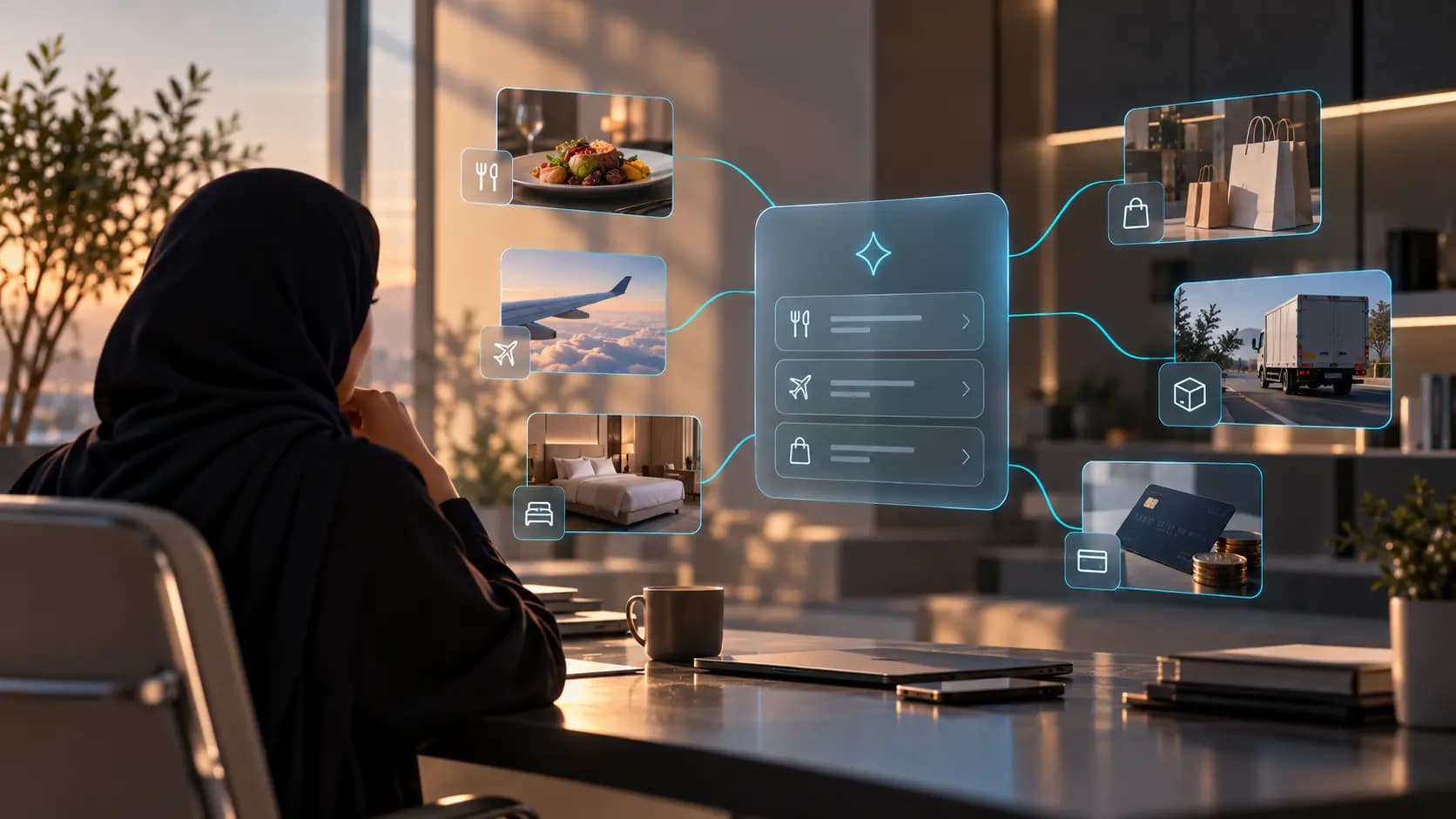
You would no longer need to open one app for flights, another for hotels, a third for transportation, and a fourth for insurance. What matters is a trip that meets your requirements. How that trip is assembled from multiple services happens behind the interface.
Or, as a business owner, you might say:
“I need this quantity of construction materials delivered to three sites within two weeks, including storage, transportation, and insurance.”
Instead of contacting a supplier, then a carrier, then a warehouse, then an insurer, an integrated offer could be assembled from different providers based on price, availability, and their ability to meet the requirements.
You could ask a single interface to compare financing offers, arrange an international shipment, find an expert for a specific task, or renew your company’s subscriptions on the best available terms, without knowing in advance which apps or platforms will execute each part.
Here, the user does not choose the tool first. They express their intent.
Instead of asking:
“Which app should I open?”
They ask:
“What do I want to get done?”
Who Enters Whose World?
Today’s apps are built on a simple assumption:
If customers want your service, they must come to you.
They download your app, create an account, enter their information, learn how you categorize your services, search within the boundaries you have defined, use the payment methods you accept, and follow the journey you designed for them.
Even when their need spans several providers, customers are expected to break it down themselves into parts that fit the available apps.
They book the flight in one place, accommodation in another, and transportation somewhere else. Or they purchase goods from a supplier, find a carrier, arrange storage, collect invoices, and coordinate execution across all parties.
In other words, today’s app tries to bring the customer into its world.
The next generation of services will try to bring itself into the customer’s world.
It will not ask customers to reshape their needs around its menus and fields. It will receive the need as the customer understands it, then offer the part it can fulfill within the broader context of what the customer wants.
If the customer is traveling, the airline enters a journey planned around the customer rather than requiring the customer to enter the airline’s world.
If they are building a project, the supplier, carrier, warehouse, and financier enter the project plan rather than forcing the project owner to move between their separate worlds.
And if someone is looking for dinner, restaurant and delivery options enter their evening, budget, and preferences rather than requiring them to spend the evening browsing menus.
This shift redefines what we consider an interface.
The interface may no longer be the screen of a specific company. Instead, it may become a layer that represents the user, carrying their context, preferences, identity, and payment methods, then calling on the services they need when they need them.
Apps will not technically disappear.
Systems will still be needed to manage inventory, reservations, trips, payments, and customers.
But apps may shift from destinations we visit to capabilities operating in the background.
And that changes the unit of competition itself.
Companies will no longer compete only to get users to open their apps. They will compete to make their services the most suitable ones to enter the customer’s world at the moment they are needed.
Whoever Owns Demand Owns the Margin
To understand the economic impact, we first need to ask:
Why are today’s intermediary platforms able to take such a significant share of each transaction?
Technology alone is not the reason.
The reason is that they aggregate demand.
A restaurant can prepare food. A driver can deliver it. A hotel can provide a room. A manufacturer can produce goods.
But all of them need customers.
The platform promises that it knows where those customers are, can bring them in, earn their trust, and make the platform the starting point of their journey.
So the platform is not merely selling a technology service.
It is selling access to demand.
Over time, network effects emerge. The more customers a platform attracts, the more suppliers want to join. And the more suppliers it has, the more attractive it becomes to customers.
Eventually, leaving becomes costly for both sides, and the commission evolves from payment for a specific service into a toll on a road that is difficult to avoid.
This does not mean platform commissions provide no value.
Platforms spend on marketing, technology development, supplier verification, payments, customer service, dispute resolution, and sometimes operations, transportation, and guarantees.
But their real economic power comes from standing at both the beginning and the end of demand.
If the beginning of demand moves to another interface that represents the customer, this advantage begins to weaken.
The question will no longer be:
“Which platform will I use?”
It will become:
“Which combination of services can fulfill my request on the best terms?”
And when a customer interface can request offers from multiple platforms, suppliers, and service providers at the same time, each platform becomes one option among many rather than the only market through which the customer sees the world.
This could mark one of the biggest shifts in the platform economy:
The separation of demand ownership from service execution.
From Bundled Commissions to Real-Time Margins
In today’s model, a platform bundles several functions into a single transaction, then charges a commission or fee based on the total value of that transaction.
Those functions may include discovery, comparison, payment, delivery, guarantees, and customer service. The seller or customer may find it difficult to determine the cost of each function individually.
In the emerging model, the transaction may be broken down into independent capabilities:
The seller provides the product, price, and preparation time.
The carrier provides capacity, price, and delivery time.
The warehouse provides available space and storage cost.
The payment provider offers a settlement method and its cost.
The insurer prices the transaction risk.
The guarantee provider defines what it will cover in the event of failure.
The coordination service brings these elements together and oversees execution.
Instead of one large margin imposed by an intermediary that owns the entire journey, there may be multiple margins formed in real time according to the value each party provides.
A nearby driver may offer a lower price because they can complete the trip more efficiently.
A warehouse with unused capacity may reduce its price for that day.
A supplier looking to utilize excess production capacity may offer a special price for a particular quantity.
An insurer may price the transaction based on the parties’ actual track records and risk profiles rather than applying a standard price to everyone.
Price, then, becomes the outcome of a live market rather than a fixed list inside a single app.
More importantly, margins become more closely tied to actual value.
A provider with scarce capacity, reliable execution, or greater speed can command a higher return.
But a provider whose margin depends primarily on keeping customers locked inside its platform may face genuine pressure.
This does not mean prices will always fall.
During periods of scarcity or high demand, prices may rise, perhaps significantly.
But the source of that increase becomes clearer: limited availability, greater urgency, or higher risk, rather than simply the platform’s ability to charge a commission because it controls the only route to the customer.
A Market That Assembles Itself for Every Transaction
In today’s economy, companies build the service chain in advance and then try to sell it to the customer.
They contract with selected suppliers, establish a standardized operating model, define fixed packages, and then ask customers to choose from what has already been prepared.
In the new model, the service chain may be assembled only after demand appears.
Suppose a company needs to transport equipment between two cities.
The request could simultaneously reach multiple carriers, temporary warehouses, insurers, and financing providers.
The transaction could then be assembled using the carrier best suited to the shipment, the warehouse closest to the route, the appropriate insurance coverage, and payment terms that work for both sides.
For another shipment, every one of those parties could change.
There would no longer be one fixed supply chain.
The chain would form around each individual request.
This opens the market to assets and capabilities that previously sat outside the competitive landscape.
A truck returning empty.
A warehouse with two days of unused space.
A factory with idle production capacity.
An expert with availability this week.
All could become offers capable of participating in a larger transaction.
Economically, this goes beyond making comparison easier.
It increases the market’s ability to discover unused resources, price them, and connect them to demand closer to the actual moment of need.
This could improve asset utilization, reduce search and negotiation costs, and decrease the amount of time capacity remains idle.
But it could also make the market more volatile and more sensitive to reputation, availability, and real-time data.
Marketing Will Not Disappear. What Changes Is Who Must Be Convinced
A significant portion of platform spending today goes toward acquiring and retaining users: advertising, promotions, loyalty points, notifications, first-order discounts, and more discounts because a customer disappeared for two weeks and stopped opening the app.
If customers no longer begin their journey inside the app, some of these tools may lose part of their value.
A small restaurant would no longer need to convince users to download its app.
A carrier would not need to build an interface capable of competing with the largest companies.
And a service provider would not need to become widely known before earning the chance to appear.
But marketing will not disappear.
The party that needs to be convinced will change.
Today, companies market to people to persuade them to open their apps.
In the next model, companies will need to make their services worthy of being selected by the system representing those people.
Competition will increasingly depend on factors that can be read and compared:
Price, availability, execution speed, reliability, quality of outcomes, cancellation rates, complaints, guarantee terms, and data reliability.
It will no longer be enough for a company to say it is the best.
The quality of its service must be provable.
Budgets once spent on advertising may shift toward improving prices, strengthening operations, offering better guarantees, building verifiable reputations, or making services easier to discover, request, and execute.
This could create a genuine opportunity for smaller companies.
A service provider that cannot afford to buy public attention may still compete if its offer is better and its track record is reliable.
Price, reputation, and performance may become its primary marketing tools.
But we should not be overly idealistic.
A new form of advertising may emerge in which companies pay for priority placement or recommendations, just as they currently try to improve their ranking in search engines and app stores.
The competition for access to the customer will not end.
It will simply move from the app screen to the selection logic behind it.
Who Wins, and Who Loses Margin?
This shift will not distribute gains equally.
The parties most exposed to risk are companies whose power comes primarily from owning the customer interface while their operational capabilities can be easily replaced.
If a platform’s main value comes from gathering users inside its app, maintaining the same commission may become difficult when demand arrives from outside the platform and multiple alternatives compete for it.
Companies that own real, difficult-to-replicate value may become stronger.
A dense logistics network, superior execution capabilities, reliable data, strong risk management, trusted guarantees, or a license required to provide a sensitive service will remain valuable even if the app interface disappears.
Smaller providers that were previously held back by marketing and customer acquisition costs may also benefit.
Customers may benefit from broader comparison, lower margins, and services tailored to their needs.
And the market as a whole may benefit from putting idle assets to work and increasing competition.
But one new player may benefit more than anyone else:
The entity that represents the user and controls the point where demand is formed.
It knows what the user wants, when they want it, what their budget is, and what they prefer.
It then determines which services enter the competition and which offers are shown.
That is not a neutral technical function.
It is an extremely powerful economic position.
The Middleman We Cannot See
This brings us to the most important paradox.
If intermediary apps disappear from the user’s view, that does not mean the intermediary has disappeared.
It may simply mean that a new intermediary has moved closer to the user than all the apps that came before it.
The interface that carries the customer’s identity, preferences, and payment methods, understands their request, gathers offers, compares them, and decides what to show them will become the new gateway to demand.
And whoever controls the gateway to demand can build an entire economic model around it.
It may charge users a subscription to work exclusively in their interest.
It may charge a fee for each transaction.
It may collect a commission from the service provider that wins the request.
It may sell priority placement.
Or it may combine all of these models and then present them to us in a small invoice whose details, as usual, we never read.
Years later, we may discover that we did not eliminate the commission charged by delivery, booking, or commerce apps.
We simply transferred it to the entity that chooses the delivery, booking, or commerce app for us.
The new intermediary could even become more powerful than today’s platforms.
A platform knows what a customer does within its own environment.
The new interface, however, may understand the customer’s needs across multiple sectors: what they buy, where they travel, their budget, their schedule, what they reject, and what they prefer even before they explicitly ask for it.
So convenience alone is not enough.
We need to know who this interface actually works for.
Did it choose an offer because it was best for the user, or because it paid the highest commission?
Does it represent the entire market or only the providers it has agreements with?
Does it explain why an option was selected?
Can users change the criteria or review the alternatives that were excluded?
The more power an intermediary has to act on behalf of the user, the more important it becomes to understand the incentives behind its decisions.
A More Efficient Market Is Not Necessarily a Fairer One
Easier comparison and broader competition may reduce margins and improve market efficiency, but they do not guarantee fair outcomes.
Some sectors could turn into continuous auctions, pushing service providers to reduce prices to extremely narrow margins.
Quality may be reduced to indicators that fail to reflect the full experience.
And reputation itself could become a barrier for new entrants:
How do you win your first transaction if the system always favors providers with thousands of previous transactions?
New forms of price discrimination may also emerge.
An interface that knows how urgently you need something and how much you can afford may use that knowledge to find you the best price.
Or it could use the same knowledge to show you the highest price it believes you are willing to accept.
Breaking a transaction across multiple parties also creates a question when something goes wrong.
If a shipment is delayed, is the supplier responsible?
The carrier?
The warehouse?
Or the system that brought them together?
And who compensates the customer when each party performed only a small part of the overall transaction?
Today’s platforms may sometimes take significant margins, but they also give customers a single point of recourse.
If we want to break apart their margins, we must not break responsibility apart with them until it disappears between the parties.
The new market therefore needs more than connection and comparison.
It needs trusted identity, portable reputation, secure payments, clear guarantees, execution records, and fair dispute resolution.
These layers may become the true forms of intermediation in the next phase.
And they may also become the new places where profits accumulate.
What Does This Mean for Companies?
Companies that built their strength around owning the user interface should not assume that this advantage will last forever.
The next competitive battleground may not be the number of app downloads, but the number of times a service is selected to fulfill an intent.
The value of a system will no longer lie only in the quality of its interface, but in its ability to provide accurate information, transparent pricing, reliable execution, and seamless integration with the interfaces customers actually use.
Every company operating as an intermediary should ask itself:
What value do we provide if customers no longer begin their journey in our app?
Do we own real operational capabilities, or merely the gateway to them?
Can our services be requested and executed outside our own interface?
Are our prices, availability, and terms easy to understand and compare?
Is our reputation tied only to our platform’s name, or can it be proven in a broader market?
Which part of our margin reflects real value, and which part exists because we control the route to the customer?
What happens to our business model when comparison becomes nearly instantaneous?
Some companies may discover that their most valuable asset is not the app at all.
It may be their supplier network, operational capabilities, trust, financing, or risk management.
They can then transform those capabilities into services that participate in customer journeys wherever those journeys take place.
Other companies may discover that most of their value came from forcing customers to enter their world.
Those are the companies that should be concerned when services begin entering the customer’s world instead.
In Summary
Technology did not kill the middleman last time.
It changed the middleman’s form, position, and share.
We moved from a broker who knew the parties in the market to a digital platform that brought them together inside its own environment.
Now we may move from platforms we visit ourselves to an intermediary that understands what we want and assembles the service for us from an entire market without us ever seeing most of the parties involved.
Apps and systems will not disappear, but they may disappear from the front of the journey.
Intermediation will not disappear, but it may be broken into independent services and reassembled around every request.
Margins will not disappear either.
They will move from the parties that own the interface to those that own demand, trust, execution, or the ability to guarantee the outcome.
This is the most important dimension of the shift.
The question is no longer who can design the best app.
It is who has the right to enter the customer’s world, who decides which services enter with them, and who takes a share when the customer’s intent becomes an economic transaction.
Perhaps the future of the most successful apps is one in which users never need to open them at all.
As for the future of intermediaries, they do not appear to be disappearing.
They simply seem to be preparing to change seats at the table.
One Final Paradox!
Imagine telling your future assistant:
“Find me the cheapest service, with no middleman taking a commission.”
A few seconds later, it replies:
“The best option has been found and the order has been successfully completed.”
You check the invoice and find an additional line:
“Fee for finding a middleman-free service.”
And that is when we will know that the middleman did not die.
Nor did it lose its appetite.
It simply learned how to take its commission without asking us to download its app.
ODEL Team
Knowledge Library
Riyadh